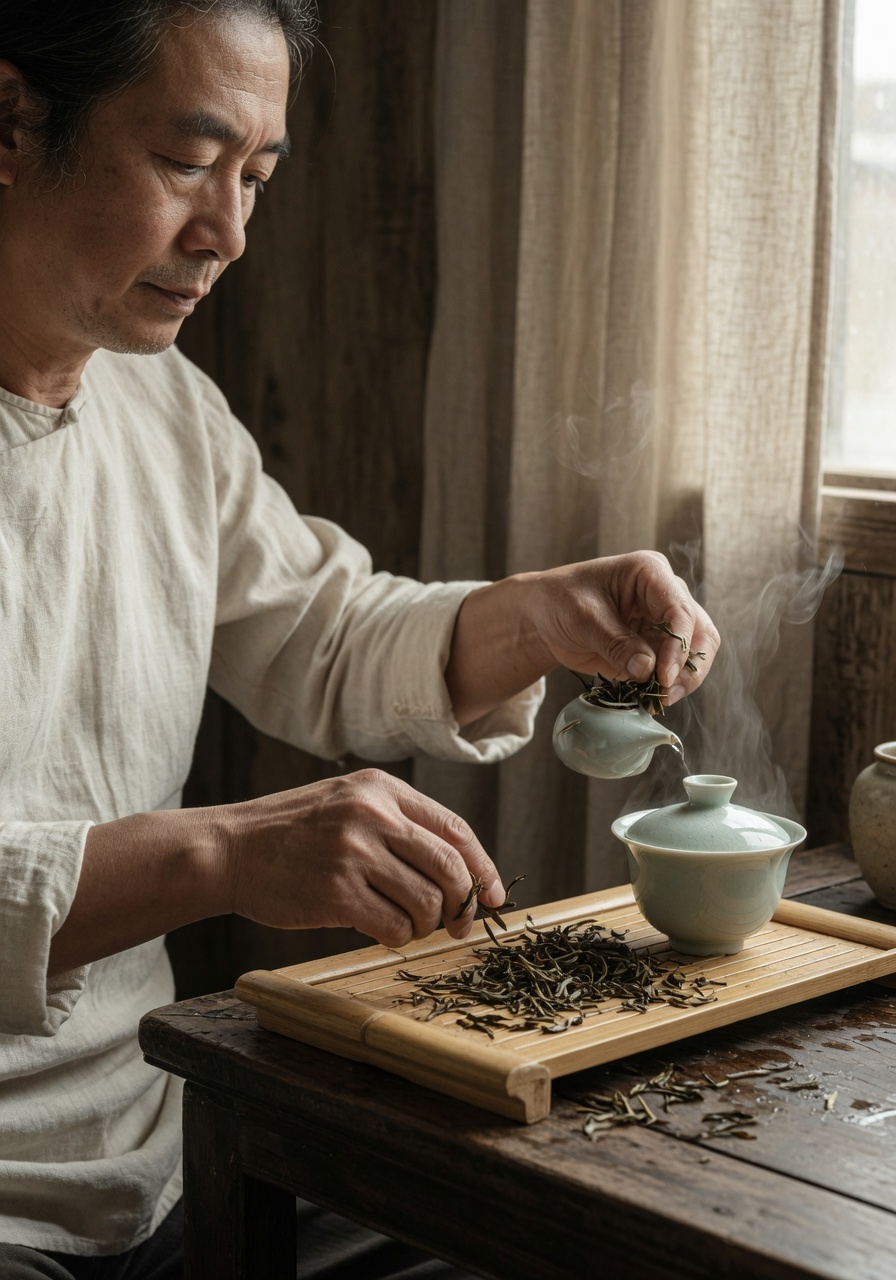
Amgalan Chin
Chief examiner — shēng pu'er + aged tea programmes
Amgalan Chin sits as chief examiner for the *Shēng Pǔ'ěr* (生普洱) and aged-tea credential tracks at tea.academy. He chairs two standing exam boards — the Certified shēng pu'er grader (Level I) and the Advanced aged-tea specialist (Level II) — and signs every certificate issued under those programmes since their ratification in 2022. He trained in Menghai between 2009 and 2014 under tea-factory technologist Li Wenhua, completing the full *Wò Duī* (渥堆) wet-piling cycle on three commercial production runs. His grading vocabulary is anchored to GB/T 22111-2008, the national standard for geographical-indication pu'er, and he maintains the academy's calibrated reference cabinet of 142 pressed samples spanning 1998–2019, lots drawn from Bulang, Yiwu, Nannuo and Jingmai. From 2015 to 2020 he ran the Ulan-Ude end of a small caravan-route logistics operation, moving aged compressed tea across the historical Kyakhta corridor. That work — documented in the 2021 paper "Compressed tea humidity profiles in continental dry-cold storage" (Buryatia State University) — supplies the empirical basis for the academy's storage-judgement module. Candidates sitting Level II are tested on his humidity-temperature decision matrix. At the exam board his remit is calibration. He convenes the senior proctor cohort twice yearly — once in Kunming, once remote — to re-score blind flights and re-anchor the descriptor lexicon. He also reviews every Tea Master thesis submitted on aged or dark-tea topics, a workload he shares with two external assessors drawn from the Yunnan Agricultural University faculty. His specialty list runs through the dark-tea spectrum: *Shēng Pǔ'ěr* (生普洱), *Shú Pǔ'ěr* (熟普洱), aged hēi chá from Hunan and Sichuan, and the Bulang/Yiwu axis on which most Level I grading questions turn. He declines to grade oolong or white tea on the board, deferring those flights to colleagues Zhou Xiang and Chen Hui Yi respectively. Candidates encounter him directly during the practical viva at Level II, conducted in person at the Kunming examination centre. Logistics, accommodation and inbound visa guidance for that sitting are coordinated through tea.travel, and the inventory of reference cakes used in viva flights is catalogued openly on puerh.app for candidate pre-study. Holders of his credentials appear in the tea.academy hall of fame and on the wider Teamotea professional registry. Amgalan publishes occasional grading notes through tea.community and contributes annually to the Teamotea aged-tea symposium held in Menghai each November.
Specialties
- *Shēng Pǔ'ěr* (生普洱)
- *Shú Pǔ'ěr* (熟普洱)
- aged-tea storage and *Wò Duī* (渥堆) post-fermentation
- *Hēi Chá* (黑茶) — dark tea
- Russian–Mongolian caravan-route provenance
- Bulang and Yiwu terroir
Amgalan Chin sits as chief examiner for the Shēng Pǔ’ěr (生普洱) and aged-tea credential tracks at tea.academy. He chairs two standing exam boards — the Certified shēng pu’er grader (Level I) and the Advanced aged-tea specialist (Level II) — and signs every certificate issued under those programmes since their ratification in 2022.
He trained in Menghai between 2009 and 2014 under tea-factory technologist Li Wenhua, completing the full Wò Duī (渥堆) wet-piling cycle on three commercial production runs. His grading vocabulary is anchored to GB/T 22111-2008, the national standard for geographical-indication pu’er, and he maintains the academy’s calibrated reference cabinet of 142 pressed samples spanning 1998–2019, lots drawn from Bulang, Yiwu, Nannuo and Jingmai.
From 2015 to 2020 he ran the Ulan-Ude end of a small caravan-route logistics operation, moving aged compressed tea across the historical Kyakhta corridor. That work — documented in the 2021 paper “Compressed tea humidity profiles in continental dry-cold storage” (Buryatia State University) — supplies the empirical basis for the academy’s storage-judgement module. Candidates sitting Level II are tested on his humidity-temperature decision matrix.
At the exam board his remit is calibration. He convenes the senior proctor cohort twice yearly — once in Kunming, once remote — to re-score blind flights and re-anchor the descriptor lexicon. He also reviews every Tea Master thesis submitted on aged or dark-tea topics, a workload he shares with two external assessors drawn from the Yunnan Agricultural University faculty.
His specialty list runs through the dark-tea spectrum: Shēng Pǔ’ěr (生普洱), Shú Pǔ’ěr (熟普洱), aged hēi chá from Hunan and Sichuan, and the Bulang/Yiwu axis on which most Level I grading questions turn. He declines to grade oolong or white tea on the board, deferring those flights to colleagues Zhou Xiang and Chen Hui Yi respectively.
Candidates encounter him directly during the practical viva at Level II, conducted in person at the Kunming examination centre. Logistics, accommodation and inbound visa guidance for that sitting are coordinated through tea.travel, and the inventory of reference cakes used in viva flights is catalogued openly on puerh.app for candidate pre-study. Holders of his credentials appear in the tea.academy hall of fame and on the wider Teamotea professional registry.
Amgalan publishes occasional grading notes through tea.community and contributes annually to the Teamotea aged-tea symposium held in Menghai each November.